
“You know you put the item somewhere safe, but safe has no address in your memory. “
This moment repeats itself across millions of households every single day, and it always ends the same way. You search for a room by hand instead of searching your mind.
The real question is not whether you forget where things go. It is whether a piece of software built specifically for memory can close that gap the moment you need it to close.
This read ultimately comes down to understanding if a AI memory assistant or personal recall app can find things you’ve lost. More importantly, can it turn scattered memories about your belongings into something you can quickly search, recall, and act on when you need it most?
What Have People Already Tried Before Turning to Memory Assistant App?
Most people go through the same three stages before they consider an AI solution.
The first stage is memory tricks. Repeating the location out loud, associating it with a rhyme, or picturing it in a specific spot. This works occasionally, but it depends entirely on consistent practice, and most people abandon it within days because life does not pause memory exercises.
The second stage is manual tracking. A notebook, or a notes app filled with locations typed out by hand. This works better than tricks, but it demands constant discipline. If you forget to log out even one item, the system has a hole in it, and one hole is often enough to make the whole habit feel pointless.
The third stage is physical trackers involving small tags attached to keys or wallets. These solve a narrow slice of the problem well. They fail completely for anything you cannot attach a tag to, which is most of what people lose. Documents, medication, seasonal items, and small tools rarely get tagged, because tagging every object in a home is neither practical nor affordable.
What Makes an AI Memory Assistant Different from a Notes Memo App?
The main distinction is searching and asking. Searching means you scan through data yourself. Asking means the system does the scanning for you and hands you the result. Speed comes from that shift, not from faster typing or better filing systems.
A notes memo app stores information. It does not understand it. If you type ten locations into a note app, retrieving one later means scrolling and reading every line until something looks familiar.
An AI memory assistant works differently because it can process what you say the same way a person would. You describe where something is, and the system finds it for you. When you ask where that item is, the assistant interprets your question the same way, matches it against what you described earlier, and gives you a direct answer.
Can an AI Memory Assistant App Deliver an Answer Instantly?
Instant is a strong word, so it is worth testing honestly rather than accepting it at face value.
When an item is saved through a quick photo and a short spoken or typed description, that record becomes searchable for text almost immediately. There is no manual filing step, no folder to choose, and no category to remember.
The AI memory assistant app reads the image, understands context, and stores the location as structured information rather than a flat note. Later, when you ask a plain question like where did I put my passport, the assistant compares that question against everything you have recorded and returns the closest match within seconds. There is no scrolling involved. There is no browsing through old photos hoping one looks right. You ask, and you receive an answer that includes the description and often the original photo as proof.
What’s the best personal Memory or Location Tracking App?
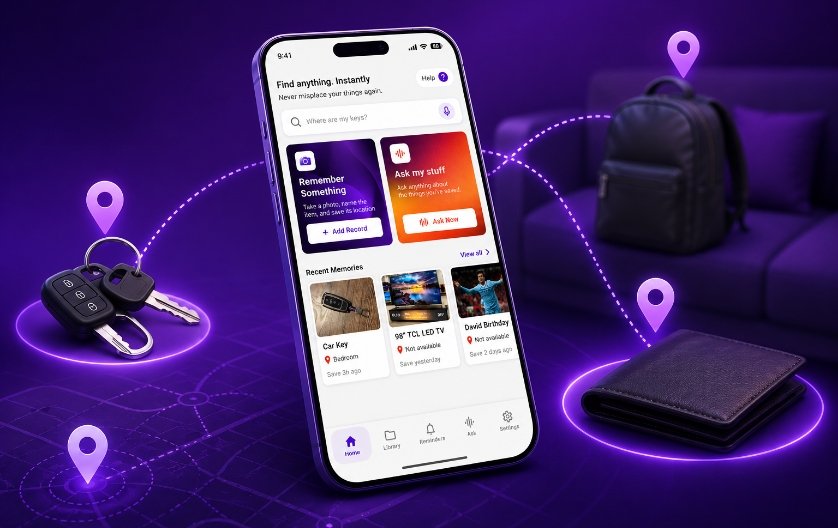
Mint Memo stands apart because it treats memory as a structured record rather than a loose collection of notes or photos. Instead of asking you to remember where something is, it asks you to describe it once through a quick photo, a short description like “top shelf, hallway closet, behind the winter coats,” and the record is saved permanently.
The app reads certain documents on its own, medicine labels, receipts, flight tickets, and hotel confirmations, and fills in the details automatically, so you are not stuck typing fields by hand. Every entry is timestamped, searchable, and stored directly on your device.
What makes Mint Memo even more genuinely useful is the “Ask My Stuff” feature, which turns the entire process into a conversation instead of a search. You do not scroll through galleries or dig through old notes hoping something looks familiar. You simply ask where an item is, and the app returns the exact location along with the original photo as confirmation in seconds.
Take a photo of a flight ticket, boarding pass, or hotel confirmation, and the app reads the details automatically, dates, destinations, booking references, and check in times, without you typing a single field. It even carries a built-in database of airports worldwide, each mapped to its correct time zone, so departure reminders fire at the right local time no matter where you are or what time zone your phone is set to.
How It Benefits: Does It Reduce Stress, or Just Save Time?
Time savings get most of the attention, but the deeper benefit is mental health. Every unresolved lost item sits in the back of your mind as an open loop. Open loops create low level stress even when you are not actively thinking about the missing object.
Even psychologists have long noted that unfinished tasks occupy mental space until they are closed. This idea has a name, the Zeigarnik effect, and it explains why an unresolved question like “where did I put that” can quietly linger, even when you are busy with something else entirely. The brain does not like loose ends, so it keeps checking back on them, pulling a small amount of attention away from whatever you are actually trying to focus on.
An AI memory assistant closes that loop the moment you save an item, because you no longer need to hold the location in your head at all. The system becomes the place where that information lives, which means your mind is free to let it go completely. There is nothing left to circle back to, nothing left to half remember later in the day.
This frees attention for things that do require thought, rather than things that only require storage. Moreover, people often describe this shift as a quiet sense of control. It’s not excitement, it’s not relief, it’s just the calm that comes from knowing the right answer exists and will come to you instantly.
Is This Realistic for Everyday Use, or Just for Rare Emergencies?
The right way to test this question is not to ask how severe a lost item feels. It is to ask how often the underlying trigger actually happens. Tools built only for emergencies rarely survive long term use, not because they fail when called upon, but because months pass between one use and the next. By the time the emergency arrives, the habit has already faded, and the tool sits forgotten exactly when it matters most.
This is where the comparison to rare emergencies breaks down completely. Emergencies do not test whether a habit is realistic. They test whether a habit survived long enough to still be there when needed. The real test happens earlier, in the ordinary five second moment of setting something down. If capturing that moment feels effortless, a photo and a short sentence, it fits naturally into what someone is already doing.
The Simple Answer
A tool that asks so little of you that using it barely registers as a task is a tool built for daily life. It does not demand a new routine, another complicated system, or constant effort to keep it useful. You simply save something when it matters, and when the moment comes that you cannot remember where it is, the system does the remembering for you.
Now this kind of simplicity matters because the best everyday tools are the ones that fit into life without asking life to change them. When a tool like that becomes useful to enough people, it does not stay small for long. It can quietly change how people organize their homes, their documents, their belongings, and eventually how much they expect technology to remember on their behalf.
The value is not just in finding a lost item faster. It is in removing a small but recurring mental burden from everyday life. The more often that happens, the more natural it becomes to expect your tools to carry the memory load instead of asking you to carry all of it yourself.