
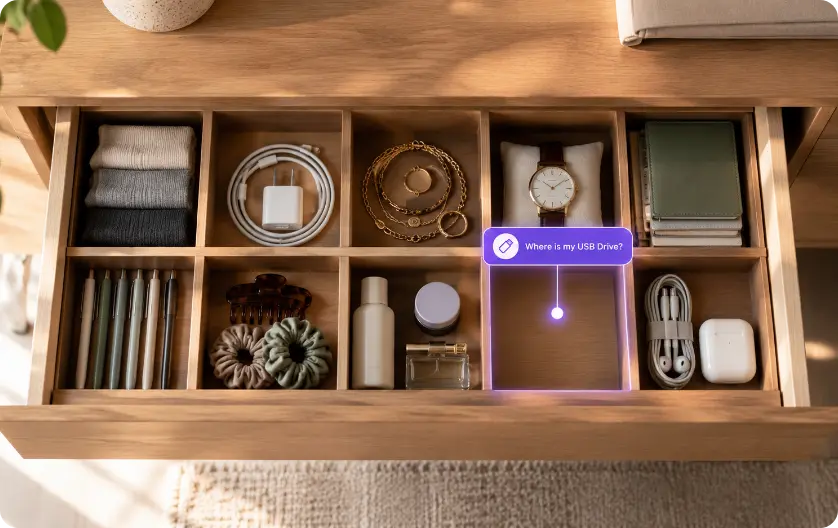
Most home organizing is designed for the moment you put something away, not the moment you go looking for it. Those are two different problems. Clearing a counter takes seconds and no thought.
Remembering the decision, you made in those seconds takes months of it. A system built only for the first one will look finished and still fail you, because tidiness and recall aren’t the same job, and only one of them ever gets planned for.
So the real question isn’t whether your home is organized. It’s whether the way you organized it was ever meant to help you remember.
Home Organization Tips That Work
Most home organization tips or advice fall apart within a few weeks. You buy the bins, you sort through the drawers, you feel great about the results, and then life happens.
Gradually, the clutter returns. The bin you labeled so carefully gets used for the wrong things. The system you built works for about a month, and then you’re back where you started, just with nicer containers.
The reason most organization systems fail isn’t effort. It’s that they rely entirely on memory and habit, and both of those have limits. This read focuses on organization tips that are practical, specific, and designed to hold up over time, not just for the week after you’ve reorganized.
These are some tips that can prevent important things from disappearing inside your organized home.
1. Start With Less Storage
The most consistent advice from professional organizers is also the most counterintuitive:
“Don’t buy storage solutions before you’ve decided what to keep.”
Professional organizers advise buying bins until after you’ve purged, so you can see what you need. The bins you already have can work as limits. Buying bins first is the single most common organizing mistake, because it leads to beautifully contained clutter rather than an organized space.
The practical rule is to go through space first. Pull everything out. Decide what stays. Only then figure out what kind of storage the remaining items actually need. A good question to apply to every item is whether it has been useful or productive in the last 12 months. If the answer is no, it probably doesn’t need a permanent home in your space.
Knowing where things are helps you understand your personal inventory and stops you from buying more of what you don’t need.
2. Give Every Item a Specific Zone
“Somewhere in the kitchen” is not a zone. “Second drawer to the left of the stove” is a zone. The more specific about the location, the more likely you are to find the item later, and the more likely whoever else lives with you is to put it back in the right place.
This sounds obvious. It is also the step most people skip. They sort things into categories but stop short of assigning a precise location. The result is a “kitchen stuff” area that contains anything vague enough to feel kitchen adjacent.
A spare charger, a travel adapter, seasonal medication, and a spare set of keys are some of the many items that disappear for months and then reappear at the worst possible moment. Giving them a named, specific location and recording it somewhere you can check later is the difference between a system that holds and one that doesn’t.
Tools like Mint Memo are useful here precisely because you can save the exact location and find it later by asking rather than searching, making it a practical tool for maintaining the system you’ve built.
3. Give Storage Seasonal Rotation
There is no reason for seasonal clothing to take up prime real estate in your main storage. Sweaters and boots in summer belong in a bin in a crawl space or attic, not blocking access to the things you use every day.
This principle applies beyond clothing. Holiday decorations, seasonal sports equipment, camping gear, and off-season kitchenware all fall into the same category. Even though they are needed a few times a year and forgotten the rest of the time, they take up the most accessible space in your home because nobody moved them after the season ended.
A simple rotation system can box up what you won’t need for the next four to six months and move it to secondary storage at the end of every season. Label the box specifically, not “winter stuff” but “winter coats, scarves, gloves.” If you photograph the box and save its location before you store it, you won’t spend an hour searching for the right box when the season changes.
4. Handle Paper the Day It Arrives
Paper is the fastest way for an organized space to become disorganized. A single week of ignored mail, receipts, and documents can pile up into an overwhelming backlog that becomes easy to keep ignoring.
The simplest rule is to deal with paper the day it arrives. Open the mail. Act on what needs action, file what needs filing, shred what needs shredding. Anything that goes into a “deal with later” pile will stay there longer than you planned.
Now some documents are too important to throw away, but you may only need them once or twice a year. You can keep them safely in a physical folder, but months later, the real problem becomes remembering where you put them and what is inside. When you finally need one, you end up searching through folders, drawers, and old papers just to find it.
Smart memory apps can store important documents and track where the originals are kept, closing the gap between “I know I have that somewhere” and “Here it is.”
5. Make Sure to Label Honestly
Every home has a junk drawer. Professional organizers don’t tell you to eliminate it. They tell you to contain it.
The junk drawer works as a home organization tool for things that don’t have a category but come up often enough to need to be accessible. However, it fails when it becomes the default destination for anything that doesn’t have an obvious home.
Once its full, things start piling up beside it, then on the counter, and then all over the room. The fix is to go through it every few months, remove anything that has found a better home, and resist the habit of putting things there when you’re not sure where else they go.
6. Apply “One In, One Out” Rule
If a space is already at capacity, adding something new without removing something old means the space will be over capacity within a month. The one-in, one-out rule is a maintenance rule, not a decluttering rule. It doesn’t fix a cluttered space. It keeps a sorted space from becoming cluttered again.
Apply it to closets, bookshelves, kitchen cabinets, and anywhere that tends to fill up faster than it empties. When something new comes in, something old goes out. The friction of that decision is what prevents gradual accumulation from undoing the work of an organizing session.
7. Record What You Have and Where It Is
The part of home organization that most systems skip entirely is the memory layer. You can build a perfect system on a Saturday, and by February you’ve forgotten which shelf the spare batteries are on, which box the holiday decorations went into, or whether you even still own the thing you’re looking for.
The practical fix is a location record. For items you put away seasonally, items you store in secondary locations like a garage or storage unit, and anything you might need to find quickly in a high-pressure moment like travel, keep a note of where it lives and what it looks like.
Mint Memo handles this as a dedicated function of photographing the item, describing the location, and retrieving it later by asking. Even a simple text note or a photo with a caption serves the same purpose. The point is to close the gap between a well-organized space and one you can navigate months later.
8. Holding Everything Together
The last and yet best organizational tip is the simplest of all. It is to put things where they belong, every time, and know where that is.
Every organization system eventually comes down to the ten-minute reset. At the end of each week if daily feels too ambitious, spend ten minutes returning things to where they belong.
You don’t have to do a deep clean or full reorganization all the time. Just the daily drift of putting jacket on the chair, the keys on the counter, the items that migrated out of their designated spots is enough for a good start.
It’s a decision you make repeatedly, in small ways, until it stops feeling like a decision at all. Get that part right, and the rest will take care of itself.
Happy organizing!