
A warranty is a written promise from the maker or the seller. It says that if the product fails in a certain way, within a certain time, the company will repair it, replace it, and can even refund it.
Most cover manufacturing faults, not damage you caused. A one-year warranty on a phone covers a battery that stops holding charge. It does not cover a screen you cracked on the pavement.
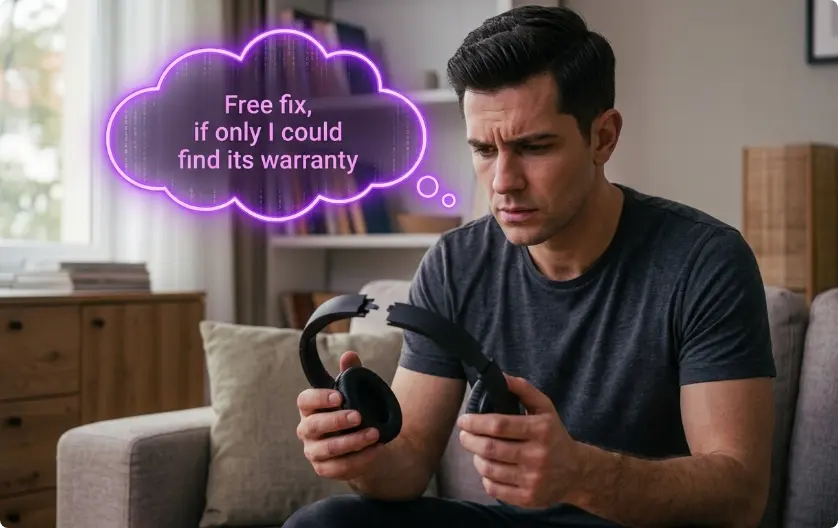
Although the majority of people don’t think about a product warranty until the day something breaks. The washing machine stops mid-cycling, the laptop screen flickers and dies, and the air conditioner runs but never gets cold. These are a few moments where having a warranty matters most, and it is also the moment most people realize they have no idea if they still have one.
This read looks at what a product warranty costs you when you forget about it, and what you can do to stop it from happening again.
How Does Forgetting a Warranty Cost You?
You pay for a repair, only to find out later that the item was still covered by warranty. The worst part is knowing you could have avoided the bill if you had remembered the warranty and had the details ready.
However, the feeling when the receipt is lost, the warranty date is forgotten, and you cannot remember where you bought it is awful. In this situation, paying out of pocket can feel like the only option left to cover the cost.
These are the many ways forgetting a warranty usually costs:
- The most obvious cost is money. A repair that should have been free becomes a bill. A fridge compressor, a laptop motherboard, a car part, a boiler pump are the kinds of repairs warranties are designed for, and they are rarely cheap. People often pay hundreds for a fix they were already entitled to, simply because they could not prove it in time.
- The second cost is paying for a replacement that could have been covered through warrranty. Many people never even ask. They assume the cover has run out, shrug, and pay. Or they replace the whole product because replacing feels simpler than digging through drawers for a receipt. A perfectly repairable machine gets thrown away while its warranty was still live. This way money gets lost, and a working product gets wasted at the same time.
- The third cost is time. If you do remember the warranty but cannot find the paperwork, you end up searching for email folders, shoeboxes, and photo galleries. You call the shop. You wait on hold. You get asked for an invoice number which you never note down. Some people spend more time proving the claim than the repair was worth and give up halfway through.
Do You Need a Receipt to Claim a Warranty?
Here is a detail that catches people out. Having the warranty is not enough. You usually have to prove it.
Most sellers ask for proof of purchase before they will accept a claim. This means the receipt or invoice, with the date and the item on it.
Some also want the model number, the serial number, or a registration you were supposed to complete when you bought the item. Without proof, a valid, in-date warranty can still be refused, and that is a frustrating way to lose a claim.
This is why people who keep a clear record tend to have better outcomes than people with the same product and the same fault. The product did not change. The evidence did.
Can You Still Claim If You Lost the Paperwork?
It is still worth checking before you pay for a repair. Look up the product model and see what standard covers, because some appliances carry longer terms than people expect.
Search your email for the order confirmation, since that often works as proof of purchase. Check whether the card you paid with adds extra cover. Ask the seller directly, because many keep purchase records tied to your account or phone number even when you have lost the receipt.
Remember that a warranty is only as good as your ability to find it. The cover is real, the money it saves is real, and the only thing standing between you and a free repair is usually a date and a receipt you did not write down. Record it once, keep the proof with it, and let something else remember the deadline for you.
What If You Already Paid for an Extended Warranty?
There is one more version of this that sting more than the rest. Extended warranties and protection plans are paid separately, often at the till or as an add on at checkout. You spend real money on cover you might never use.
If you forget you bought it, you have paid twice. Once for the plan, and again for the repair you could have claimed. The same goes for cover you get without paying, like the extra warranty months some credit cards add to purchases, or the manufacturer promise that came free with a major appliance. Free or paid, cover you cannot remember is cover you do not have.
How Do You Keep Track of Your Warranties?
The fix is not complicated, but it has to be consistent. Three habits cover most of it.
Capture Details
Capture the details at the moment you buy them. Note the item, the date of purchase, the seller, the length of the warranty, and the model or serial number. Remember that 2- minutes on the day of purchase is worth more than an hour of searching later.
Save Receipt
Keep the proof with the details. A photo of the receipt, the invoice email, and the warranty card should sit in the same place as the note, not scattered across your camera roll and inbox. Printed receipts fade, so photograph them early.
Check Coverage
Set a reminder before the cover ends, not on the day it ends. A nudge a month out gives you time to inspect the product, notice a fault you had been ignoring, and make a claim while it still counts.
If you want a solution that does all the job for you. Mint Memo keeps the details, proof, and warranty reminders together, so you don’t have to remember where you saved them. It keeps warranties as proper records rather than loose notes, so the purchase date, the cover period, the seller, and the receipt photo all stay together and stay searchable.
How Mint Memo Helps You Avoid Uncovered Repair Costs?
People generally end up paying for nothing in four ways upon using MInt Memo:
You Use Warranty in Real-Time
You check the details and find the appliance, phone, laptop, or car part is still covered. Instead of paying for the repair yourself, you use the warranty you already had.
You Avoided an Unneeded Claim
You check the coverage and repair terms before paying. The repair is cheaper than the deductible, or the manufacturer covers it anyway. You avoid paying the deductible and using a claim for no reason.
You Caught a Double Charge
You have the original estimate and invoice in one place. That makes it easier to spot a deposit that was not deducted, a part charged twice, or a repeat visit billed as a new job.
You Got the Repair Fixed Timely
The same problem comes back within the shop’s guarantee period. You have the repair details and date ready, so you can go back to the shop and avoid paying for the same repair twice.
Conclusion
The point is not to keep every receipt, warranty, and repair record in your head. It is to have one reliable place where those details are kept and ready when you need them.
When something breaks, you should be able to check what you bought, when you bought it, what is still covered, and what you have already paid for without digging through old emails or drawers.
This makes life a little easier because you are no longer relying on memory at the exact moment you need an answer. You have something accountable for keeping track of the details for you. The outcome is fewer missed warranties, fewer unnecessary repair bills, and less time spent trying to remember where you put something.