
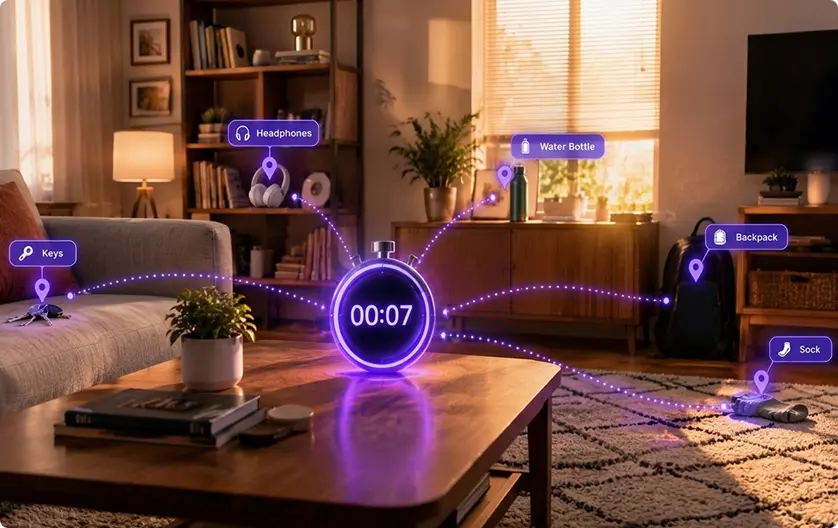
You know the walk. Kitchen. Bedroom. Back to the kitchen. Then the same drawer you already opened twice, because maybe it changed its mind in the last forty seconds.
Nobody searches calmly. We search like the house is hiding things on purpose and somewhere around minute six, we start blaming family members who weren’t even home.
The rule worth stealing when you can’t find anything is quite simple. If it takes more than ten seconds to find something, you don’t lose the thing. You lost the note about where it went.
This read explores the small shift that can turn your home from a place where things disappear into a place where you can predict where they are.
1. Write Down If It’s Not There
Ask people where they put something they can’t find, and there’s a good chance they’ll say, “I put it somewhere safe.” Although that might sound smart at the time, the problem is that “safe” often means somewhere unusual, not somewhere memorable.
The problem shows up later when you need the item, but you’re thinking like your normal self. You don’t remember what you were thinking when you put it away. You search for the usual places first, then the less usual ones, and eventually the whole house starts looking suspicious.
Even though the item isn’t lost, what gets lost is the reason you chose that particular spot. So don’t rely on memory for unusual storage. If you put something important somewhere you don’t normally keep it, write down where it went.
A quick note into Mint Memo can save you ten minutes of searching later. Something your future self should not have to solve a mystery created by your past self.
2. Put It Back Where You First Looked
This goes against a lot of organizing advice, but there is a useful idea behind it. When you lose something, notice where you look first.
If you keep checking the same drawer for scissors, the same shelf for your charger, or the same cabinet for medicine, that first search is telling you something.
Your brain already connects that item with that location, even if you never officially decided that was its “proper” home.
So, when you finally find the missing item, consider putting it back where you looked first. You are not creating a perfect storage system. You are using a location your brain already knows to look in.
Remember that a beautifully labelled drawer is useless if, when you are tired or in a hurry, your brain automatically sends you somewhere else.
The point isn’t to ignore sensible organization. It’s to notice your real habits and use them. Your first search is useful information about where you naturally expect something to be.
3. Change the Way You Look
When something small goes missing, searching from a standing height is often the problem. Get down low instead and put your phone flashlight or a torch flat on the floor and shine it across the room.
A screw, earring, key, SIM card, or anything else small can cast a long shadow in a low beam. Something you could not see from above can suddenly become obvious.
When something falls, your eyes often look at the place where you expect it to land instead of following the object itself.
Make a habit of tracking it for that extra second. If you see where it lands, you eliminate most of the search before it even starts.
The same idea works for things that leave a trail. When you lose your wallet, try checking your recent card payment and think about the last place you used it.
When you can’t find something, you carried outside, retrace the last place you remember using it instead of visiting every other place you might have visited.
Remember that finding things faster is often less about searching every corner and more about using clues that narrow the search.
Every useful clue removes another place you have to check. That’s what gets you closer to ten seconds.
4. Save More Than a Photo
Don’t let your camera roll become your filing cabinet. Your phone is probably full of useful photos you took for a reason.
Taking photos is smart. The problem is what happens after that. It gets buried between screenshots, food photos, and hundreds of other pictures, with no clear way to find it when you actually need it.
If a photo contains information, you may need later, give it a name or place outside your camera roll. Add a short note about what it is and why you saved it.
Instead of remembering, “I have a photo of that somewhere,” you should be able to remember, “I saved the boiler serial number,” and find it immediately.
You can use Mint Memo by taking the photo as usual, but instead of leaving it in a giant camera roll, you save it as a useful record.
The goal isn’t to take fewer photos. It’s to make sure the useful ones don’t disappear into the pile.
The less time you spend scrolling through your camera roll, the less time you spend searching for information you already saved.
5. Make Direction Findable
Describe the spot like a stranger has to find it. Unfortunately, this is the part almost everyone gets wrong.
“In the storeroom” is not a location. “In the office” is not a location. “Somewhere in the garage” is a confession.
A real location sounds like a second drawer of the grey cabinet in the storeroom, behind the router box, in the blue zip pouch.
Read that back. You could find it in seven seconds without ever seeing the room. This is also why keeping it in your head fails.
Mint Memo makes that record easier to use. Type or say what you’re looking for and use the “Ask My Stuff” feature to find the saved item and show its exact location along with the original photo and details.
You can also add or change the location whenever the item moves, so the record stays useful instead of becoming another thing you must remember.
Remember that a saved location doesn’t fade with time. It stays just as specific months later as it was the day you saved it.
6. Start With the First Five
You don’t need a whole weekend. Start with the things that hurt most when they go missing. Pick five panic items, photograph each one where it actually sits, not where you think it should sit. Write the location the way a stranger would need to read it.
Save it somewhere you can easily search later. A notes app can work, but a tool like Mint Memo takes it a step further by keeping the information organized and adding reminders.
Instead of simply remembering where you saved your passport, you can also get a reminder before it expires. You can update it whenever the thing moves.
Start with the things you would panic about losing, not the things you use most often. Those are the items where a few seconds of preparation can make the biggest difference.
This way five seconds of effort can save you ten minutes of late searching.
Wrapping Up
The best organization system is not the smartest on Sunday afternoons. It is the one you can follow on a busy Tuesday when you are half asleep and looking for something in ten seconds.
If your habits keep pointing to the same place, stop fighting them. Your home should work with your memory, not require you to remember a completely new system.
At the end of the day, you’re not trying to become a person with a color-coded pantry. You’re trying to stop wasting ten minutes looking for something you know you own.
The easiest way to do that is to make your home work with the way you actually live. Keep useful information where you can find it. Give important things a clear place, and when something is easy to forget, don’t make your memory do all the work.
The goal isn’t a perfectly organized home. It’s a home where the things you need don’t make you stop and search for them. Make “Where did I put that?” a much shorter question with Mint Memo.